
Circles
The project was developed using a Design Thinking process across empathise, define, ideate, prototype, and test. Research, wireframing, high-fidelity prototyping, and usability evaluation were used to shape a circle-based sharing experience centred on privacy and confidence.
Objective
The goal of this project was to design a social sharing experience that gives users greater control over privacy and audience selection. The focus was on making audience management faster, more visible, and more reassuring during the act of posting. I set out to explore how reusable audience groups could reduce repetitive privacy steps and help users feel more confident when sharing personal content.
My role
I led the project end to end, from initial research through to high-fidelity prototyping and usability evaluation. My work included secondary research, interviews, surveys, competitor analysis, affinity mapping, personas, ideation, wireframing, interface design, and testing. I also translated research insights into a working product concept, built the high-fidelity prototype in Figma, and iterated the design based on usability findings.
Challenge
Current social media platforms make it easy to share publicly, but harder to share with the right smaller group. The report found that users often struggle with repetitive privacy settings, unclear audience visibility, and limited support for custom groups, which can lead to hesitation, workarounds, or not posting at all.
This problem became especially important for users managing different social contexts, such as family, close friends, university peers, or private circles. The project reframed sharing as a privacy and trust challenge rather than only a content-posting task.
Research
The research combined secondary research with primary qualitative and quantitative methods. The study included semi-structured interviews, usability-style task observation, surveys, competitor analysis, SWOT analysis, affinity mapping, empathy mapping, and personas.
The findings showed a clear demand for more flexible audience control. Participants reported that current audience settings felt effortful, while saved audience groups and one-tap sharing to reusable circles scored strongly in the survey.
Key findings
Users wanted contextual audience segmentation such as family, close friends, university friends, or custom groups.
77% of qualitative participants reported manual friend-list editing as a pain point with high cognitive load.
57% highlighted the lack of inline audience preview as error-prone.
Current audience control on Instagram scored 4.8/10 for ease, while changing visibility felt effortful at 7.6/10.
Interest in saved audience groups was high, with one-tap group sharing scoring 8.4/10 and privacy control through pre-saved groups scoring 8.6/10.
Half of respondents said visibility hassle sometimes stopped them from posting.
Personas
To represent different privacy behaviours, I created personas based on patterns from the research. These included a cautious user who wanted to avoid family oversharing, a group-oriented sharer who wanted Snapchat-like flexibility, and a highly privacy-conscious user who prioritised digital safety over posting frequency.
The personas helped show that privacy is not one-size-fits-all. Different users needed different levels of speed, reassurance, and control, which reinforced the need for a more flexible audience model.
Opportunity statement
This project revealed an opportunity to redesign social sharing around audience intent rather than default visibility. Instead of asking users to adapt to rigid privacy settings, the interface could adapt to the way people actually think about sharing with real social circles.
A key design question that guided the project was: how might we help users share personal content with the right people, with less effort and more confidence?
Solution
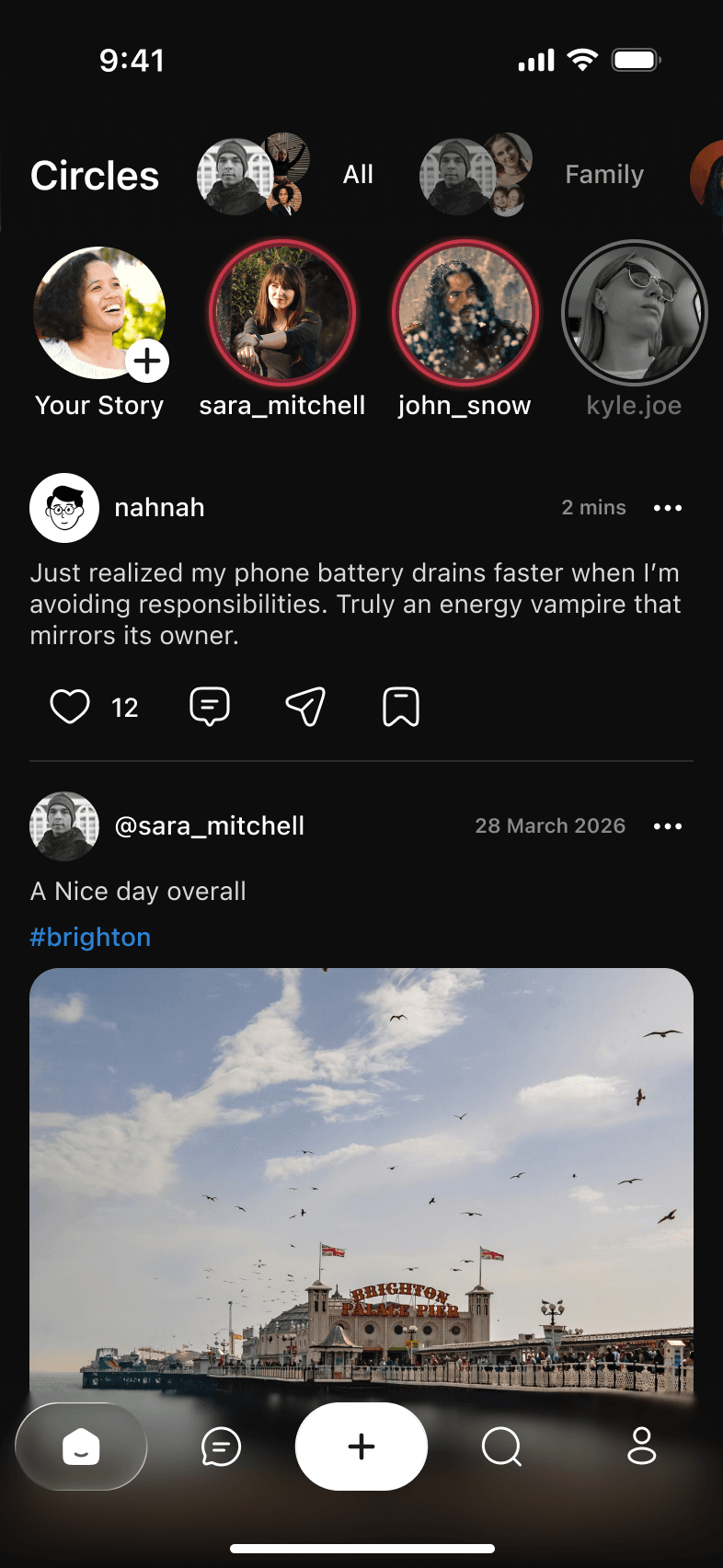
Circles is a social media concept built around reusable audience groups. Users can create circles such as Family, Close Friends, University Friends, or custom groups, then use those circles when sharing stories, posts, and other content types.
The concept shifts audience selection from a hidden setting to a visible part of the posting flow. This makes privacy control more immediate, understandable, and less mentally demanding.
Key features
The final concept included a range of features that supported both usability and privacy:
Reusable audience groups for faster repeat sharing.
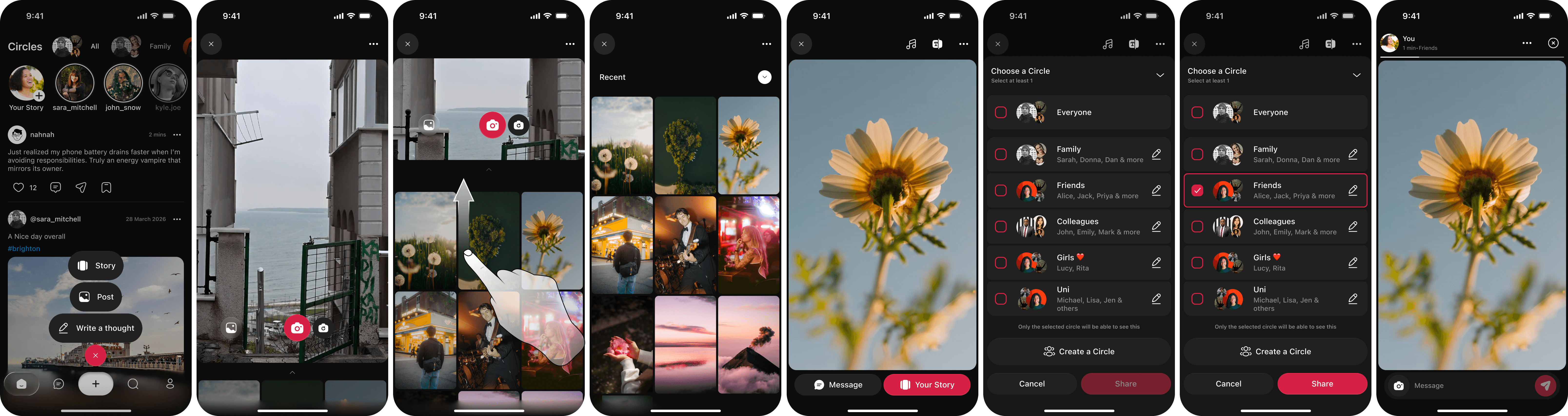
Inline audience selection within the story and post composer.
Audience confirmation before posting to reduce mistakes.
Circle management for creating, editing, and organising groups.
Circle-based feed filtering and discovery.
Privacy options within circles, including controls for likes, comments, screenshots, and sharing.
Information architecture
The app was structured around six main sections: Home, Create, Circles, Profile, Messages, and Search. This architecture reflected the main user goals identified during research, including posting content, managing audiences, browsing shared content, and controlling account privacy.
By giving Circles its own dedicated space within the product, the IA reinforced the idea that audience management was a primary action rather than a buried settings feature.
Story Composer Flow
Prototype
I developed the prototype in Figma, starting with wireframes to establish navigation, hierarchy, and core user flows. The high-fidelity prototype then expanded into a more complete system with sign-up, onboarding, home feed, story viewer, search, profile, circle management, composer flows, messaging, and settings.
The interface was designed to feel familiar enough for social media users while introducing a new sharing model centred on reusable circles and visible privacy control.
Visual design
The visual language aimed to feel modern, soft, and approachable. The interface used rounded shapes, dark backgrounds, neutral supporting tones, and a strong pink accent colour to guide attention and create a recognisable product identity.
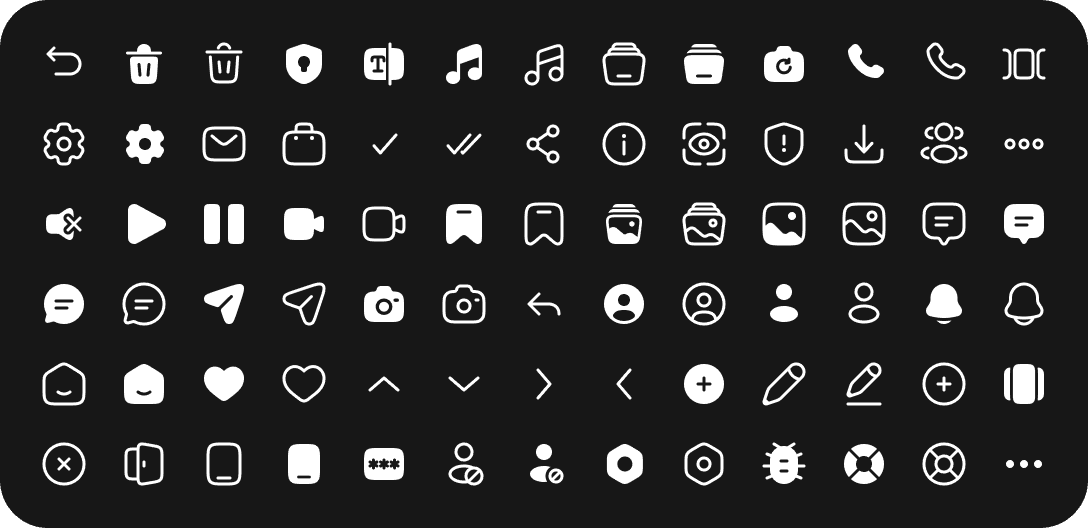
A reusable component library was also created in Figma to maintain consistency across buttons, inputs, cards, toggles, tabs, and other interface elements. During testing, icons were changed from Material Symbols to Solar Icons to improve clarity and better match the product’s visual style.

Component library
Icon Library - Solar Icons
Testing
The prototype was evaluated through a cognitive walkthrough, System Usability Scale, Product Reaction Cards, and heuristic evaluation. These methods were selected to assess both practical usability and emotional response, which was important for a product centred on privacy and trust.
The testing focused on whether users could complete key tasks such as onboarding, creating a story, selecting the correct audience, and managing circles without confusion or external help.
Results
The evaluation showed strong overall usability. Participants were generally able to complete onboarding, story creation, and post sharing successfully, and the average SUS score was 85.5, which falls into the Excellent range.
Product Reaction Card responses also showed positive emotional feedback, with participants describing the prototype as friendly, clear, responsive, trustworthy, simple, and easy to use.
Iterations
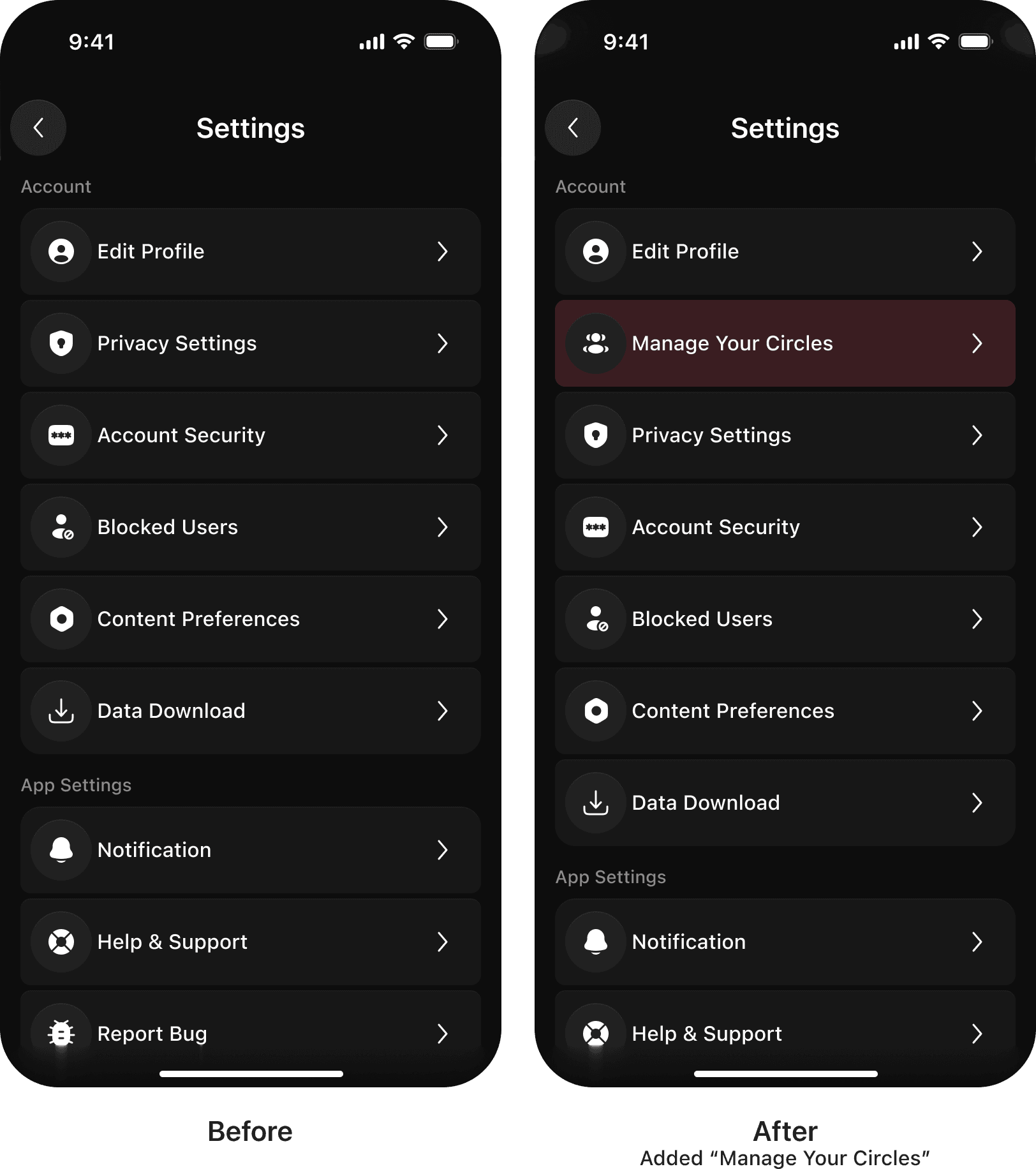
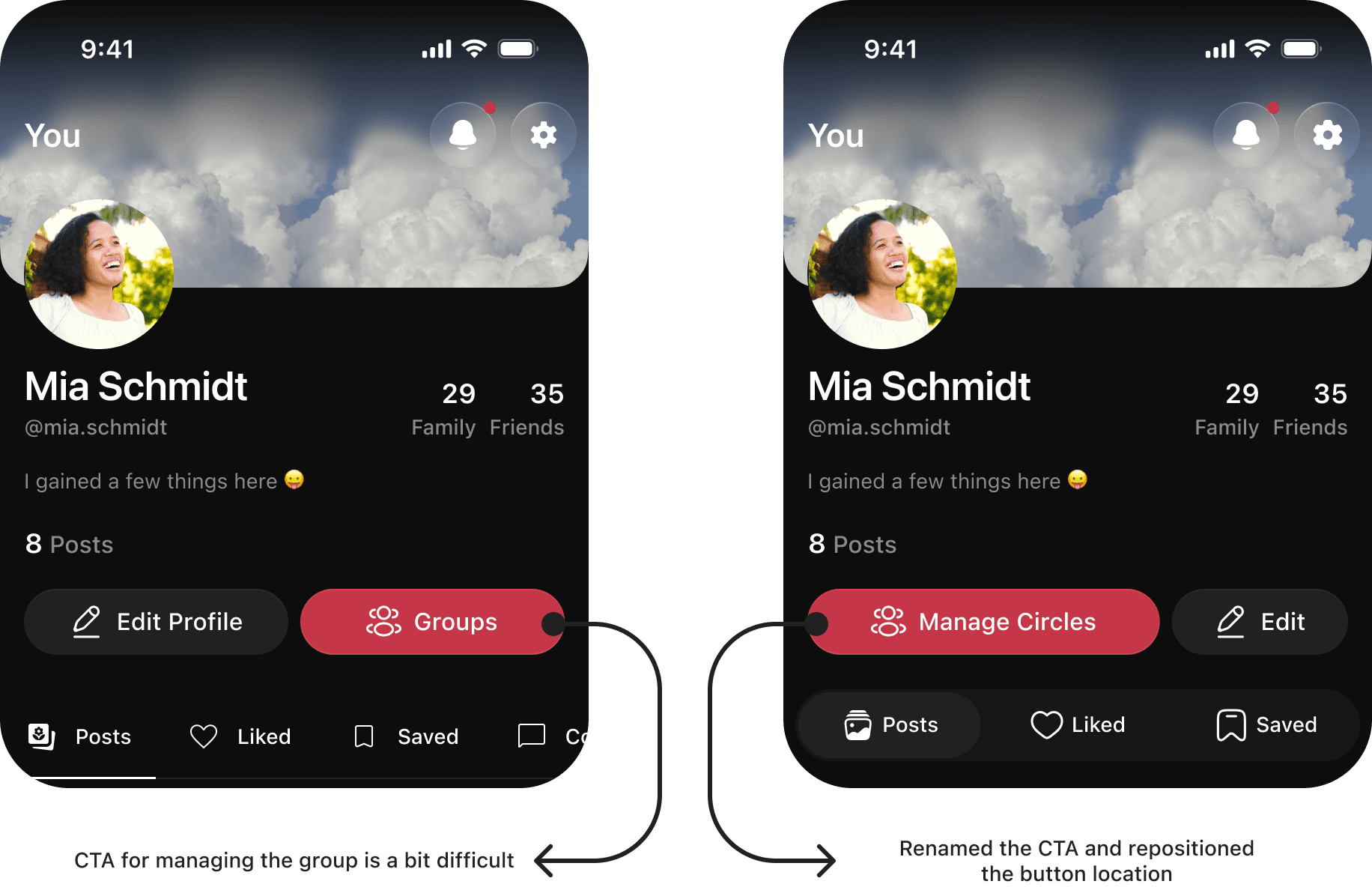
Testing revealed a few areas where clarity and error prevention could be improved. One issue was that the “Groups” CTA on the profile page did not clearly communicate that it was the place to manage circles, so the wording and placement were revised to improve discoverability.
Additional iterations included adding a second route to Manage Circles through Settings, introducing confirmation dialogs for sensitive actions, and adding visible username availability feedback during onboarding. These changes helped improve feedback, consistency, and confidence across the experience.
Outcome
Circles demonstrates how a more audience-first sharing model can make social media feel safer, clearer, and more aligned with real social behaviour. By turning reusable circles into a central part of the experience, the concept reduces friction in privacy management and supports more intentional sharing.
The project shows that designing around trust and social context can create a stronger user experience than conventional public-first posting flows.